
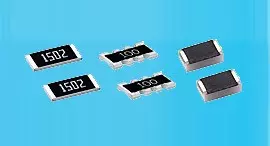

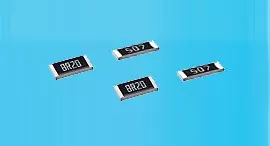

AUTOMOTIVE APPLICATIONS
Thin film Precision resistor 0.01%, TC2ppm, wirebondale, Anti-Crossive, MELF. Current sensing, Metal...
Read MoreViking Energy Management Introduction. Viking Tech has the experience in the design of innovative components, offering support and service to Global customers that demand a genuine manufacturing partner. Our goal is to be the leader in design, manufacturing, and marketing of miniature, precision passive components used throughout Automotive, Industrial and 3C electronic applications.. Viking was built in 1997 as a leader thin film precision resistor, thick film , multilayer capacitor and inductors manufacturer. Expert of manufacturing ultra-precision resistors, tolerance down to 0.01% and TCR 2 ppm in a broad range of all package sizes. With advanced thin film technologies and competitive costs, Thin film precision resistor, MELF Resistor, wirebondale, Anti-Crossive, Thin film Array, Also Multi-functions for thick film general purpose resistor and Array , Current sensing, Anti-Sulfur, Anti-Surge, High Power, High Voltage, Metal ultra low ohm design. Completed size from 01005 to 2512. TO220/247 package upto 100W We are also capable of Thin Film, Multilayer, RF and Power Inductors, which are suitable for various wireless or communication applications, the tolerance is able to down to 0.5%, and 13GHz onwards of SRF. Certified with TS16949/ ISO9001/ ISO14001 high standard quality assurance system and meet AEC-Q200 to support automotive grade products
| Comply with energy laws | Comply with applicable legal and other energy management requirements, support the procurement of energy-efficient equipment, and prioritize design activities that improve energy performance. |
| Conduct comprehensive | Conduct a comprehensive energy review by analyzing energy consumption data, evaluating equipment performance, and identifying opportunities for energy performance improvement to minimize energy waste. |
| Continuously improve | Establish and regularly review energy objectives and targets, monitor the implementation of energy-saving initiatives to ensure intended results are achieved, prioritize design activities that improve energy performance, and drive continual improvement through performance monitoring. |
| Full participation in energy | Promote employee awareness of the importance of energy conservation, provide energy efficiency training and related resources, foster a culture of accountability in energy management, and contribute to a more sustainable future. |
To achieve sustainable energy use, Viking proactively identifies energy-related risks and opportunities throughout its operations. The Company promotes energy conservation, improves energy efficiency, reduces greenhouse gas emissions, and continually enhances energy performance through its operational activities. Viking is committed to providing the necessary resources to ensure the effective implementation and continual improvement of its energy management system.
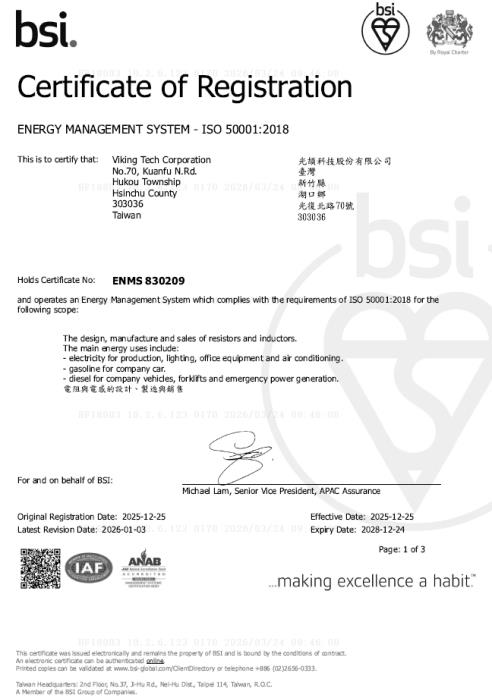
In 2025, Viking implemented an ISO 50001:2018 Energy Management System (EnMS) and successfully achieved ISO 50001:2018 certification. Through the PDCA (Plan-Do-Check-Act) management cycle, the Company continuously improves energy performance, enhances energy efficiency, reduces operating costs and carbon emissions, and ensures compliance with applicable energy regulations, supporting its environmental sustainability objectives.
To strengthen energy management, Viking has established the Energy Review, Baseline, and Energy Performance Indicator Management Procedure to effectively manage the Company's energy use. Through this procedure, the Company evaluates energy consumption, identifies Significant Energy Uses (SEUs) and energy-saving opportunities, establishes energy baselines, and develops appropriate Energy Performance Indicators (EnPIs) to achieve its energy conservation objectives.
In addition to continuously improving the energy efficiency of product design and manufacturing processes, Viking integrates energy conservation and carbon reduction practices into its daily operations and actively participates in government-sponsored energy efficiency initiatives. The Company successfully secured government funding under the Energy Performance Contract (EPC) program for energy efficiency projects across its three major manufacturing sites in Taiwan and invested NT$50 million in implementing a series of energy efficiency improvement projects. The EPC project was launched in 2024, with 2024 established as the baseline year for measuring energy savings. All improvement projects were completed in December 2025 and are expected to significantly enhance the Company's overall electricity use efficiency. The estimated energy-saving benefits are presented in the table below.
| Improvement location | Energy saving solutions | Estimated annual power saving (kWh) | Annual reduction in CO2 emissions (tons) | Expected annual energy saving (GJ) |
|---|---|---|---|---|
| Hsinchu Factory I | Replacement with Grade 1 Energy Efficiency Vapor Compression Chiller Units | 545,984 | 258.8 | 1965.5 |
| Installation of Rooftop Solar Photovoltaic (PV) System for Self-Consumption | 175,021 | 83.0 | 630.1 | |
| Variable Frequency Drive (VFD) Control for Water Pumps, Cooling Towers, and Air Handling Unit (AHU) Fan Motors | 97,498 | 46.2 | 351.0 | |
| Hsinchu Factory II | Installation of Rooftop Solar Photovoltaic (PV) System for Self-Consumption | 383,250 | 181.7 | 1379.7 |
| Variable Frequency Drive (VFD) Control for Process Cooling Water Pumps | 66,128 | 31.3 | 238.1 | |
| Waste Heat Recovery from the Compressed Air System for MAU Reheating | 473,963 | 224.7 | 1706.3 | |
| Kaohsiung Factory | Variable Frequency Drive (VFD) Control for Water Pumps and Cooling Towers | 131,409 | 62.3 | 473.1 |
| Total | 1,873,253 | 887.9 | 6743.7 | |
Note: Carbon emission reductions are calculated using the 2024 grid electricity emission factor (0.474 kg CO₂e/kWh) published by the Energy Administration, Ministry of Economic Affairs.
Electricity savings for the rooftop solar PV system are calculated based on the amount of renewable electricity generated for self-consumption that replaces grid electricity.
Energy consumption at Viking‘s Hsinchu Headquarters, Hsinchu Factory II, Kaohsiung Branch, and Wuxi Factory is primarily derived from purchased electricity, which accounted for 99.7% of the Company’s total energy consumption in 2025. The remaining energy consumption was attributable to gasoline and diesel, which were used primarily for vehicle transportation and emergency generators. Total energy consumption in 2025 was 116,919 GJ, representing a 2% increase compared with the previous year, primarily driven by higher production output. The Company will continue to improve energy efficiency and optimize manufacturing processes to reduce energy consumption.
| Factory /category | 2023 | 2024 | 2025 | ||||||||||||||||||
|---|---|---|---|---|---|---|---|---|---|---|---|---|---|---|---|---|---|---|---|---|---|
| Purchased Electricity | Gasoline | Diesel fuel | Total | Purchased Electricity | Gasoline | Diesel fuel | Total | Purchased Electricity | Gasoline | Diesel fuel | Total | ||||||||||
| MWh | GJ | liter | GJ | liter | GJ | GJ | MWh | GJ | liter | GJ | liter | GJ | GJ | MWh | GJ | liter | GJ | liter | GJ | GJ | |
| Hsinchu Headquarters | 4,029 | 14,504 | 2,976 | 97 | 902 | 32 | 14,633 | 4,239 | 15,260 | 3,140 | 103 | 917 | 32 | 15,395 | 3,934 | 14,162 | 3,779 | 123 | 836 | 29 | 14,314 |
| Hsinchu Factory II | 10,832 | 38,995 | 612 | 20 | 10 | 0 | 39,015 | 11,136 | 40,090 | 604 | 20 | 4 | 0 | 40,110 | 10,967 | 39,481 | 585 | 19 | 4 | 0 | 39,500 |
| Kaohsiung Branch | 14,373 | 51,742 | 230 | 8 | 324 | 11 | 51,761 | 15,526 | 55,894 | 59 | 2 | 260 | 9 | 55,905 | 16,573 | 59,663 | 898 | 29 | 258 | 9 | 59,701 |
| Wuxi Factory | -- | -- | -- | -- | -- | -- | -- | 850 | 3,060 | 4,312 | 186 | -- | -- | 3,246 | 903 | 3,251 | 3,558 | 153 | -- | -- | 3,404 |
| Total | 29,234 | 105,241 | 3,818 | 125 | 1,236 | 43 | 105,409 | 31,751 | 114,304 | 8,115 | 311 | 1,181 | 41 | 114,656 | 32,377 | 116,557 | 8,820 | 324 | 1,098 | 38 | 116,919 |
Note: Conversion factors for the Taiwan facilities are based on the Table of Energy Product Calorific Values published by the Energy Administration, Ministry of Economic Affairs. The conversion factors are as follows: 1 MWh = 3.6 GJ; 1 liter of gasoline = 0.03265 GJ; and 1 liter of diesel = 0.03516 GJ.
Conversion factors for Wuxi Factory are based on GB/T 2589-2020, the Chinese national standard for the calculation of comprehensive energy consumption. The conversion factors are as follows: 1 MWh = 3.6 GJ; and 1 liter of gasoline = 0.04311 GJ.
| Year | Total Energy Consumption (GJ) | Total Revenue (NT$ million) | Energy Intensity (GJ/NT$ million) |
|---|---|---|---|
| 2023 | 105,409 | 2,263 | 47 |
| 2024 | 114,656 | 2,581 | 44 |
| 2025 | 116,919 | 2,675 | 43.7 |
Note: Energy intensity = Total Energy Consumption (GJ) ÷ Total Revenue (NT$ million). The 2023 data cover the Taiwan facilities only, while the 2024 data include Wuxi Factory.
Thin film Precision resistor 0.01%, TC2ppm, wirebondale, Anti-Crossive, MELF. Current sensing, Metal...
Read More
Ceramic high frequency chip inductors, small size to 01005. Thin film, multilayer, wirewound , ferrite...
Read More
Multilayer Ceramic capacitor offers high Voltage, high frequency, low noise, High Q, Low TCR. NPO, X7R,...
Read More